The Case for Fluid Infrastructure: Redefining the UK Loading Bay
Walk into any busy parcel hub at 02:00, and you will likely see the same thing: a massive, fixed telescopic conveyor sitting idle because the vehicle at the shutter doesn’t quite fit the reach, or a team of loaders manhandling heavy cartons around a machine that has become an obstacle rather than an asset. It is a common frustration, and usually the result of committing too much capital to heavy, permanent steel that cannot move as fast as the market does.
The Problem with Permanent Solutions
For a long time, the industry assumed that “reliable” meant “bolted to the floor.” We built loading bays around fixed infrastructure, betting that volume, vehicle types, and stock profiles would remain static for a decade. They haven’t. When a hub is restricted by a rigid configuration, any shift in a contract or a change in packaging dimensions creates an immediate bottleneck.
We are seeing a necessary shift toward portable, flexible machinery. It is not about chasing a trend; it is about avoiding the trap of stranded hardware.
Why Mobility Beats Mass
If a bay is stuck in one setup, it is a liability. Portable machinery changes the operational logic. You can convert a standard dock into a high-speed unloading zone in minutes, then clear the floor entirely to facilitate palletised cross-docking when the shift requirements change.
There is also the matter of health and safety governance that actually works on the shop floor. Most musculoskeletal issues occur in that final three metres inside a trailer. We believe equipment should bring the “reach” to the operative. If the machine is easy to position, the physical strain drops. If it’s a struggle to move, the workforce won’t use it properly.
For Third-Party Logistics (3PL) providers, this is also a conversation about de-risking assets. If a contract migrates or a site layout needs a rethink, portable conveyors remain “moveable capital.” They can be loaded onto a trailer and sent where they are needed, rather than being left behind as redundant scrap.
Results from the Floor: National Parcel Distribution
A major UK parcel network recently had to scale a regional hub. They were running 24/7, and their legacy conveyors were failing, leading to unscheduled downtime and a lot of grumbling from the loaders. They didn’t need a “visionary” platform; they needed gear that wouldn’t break.
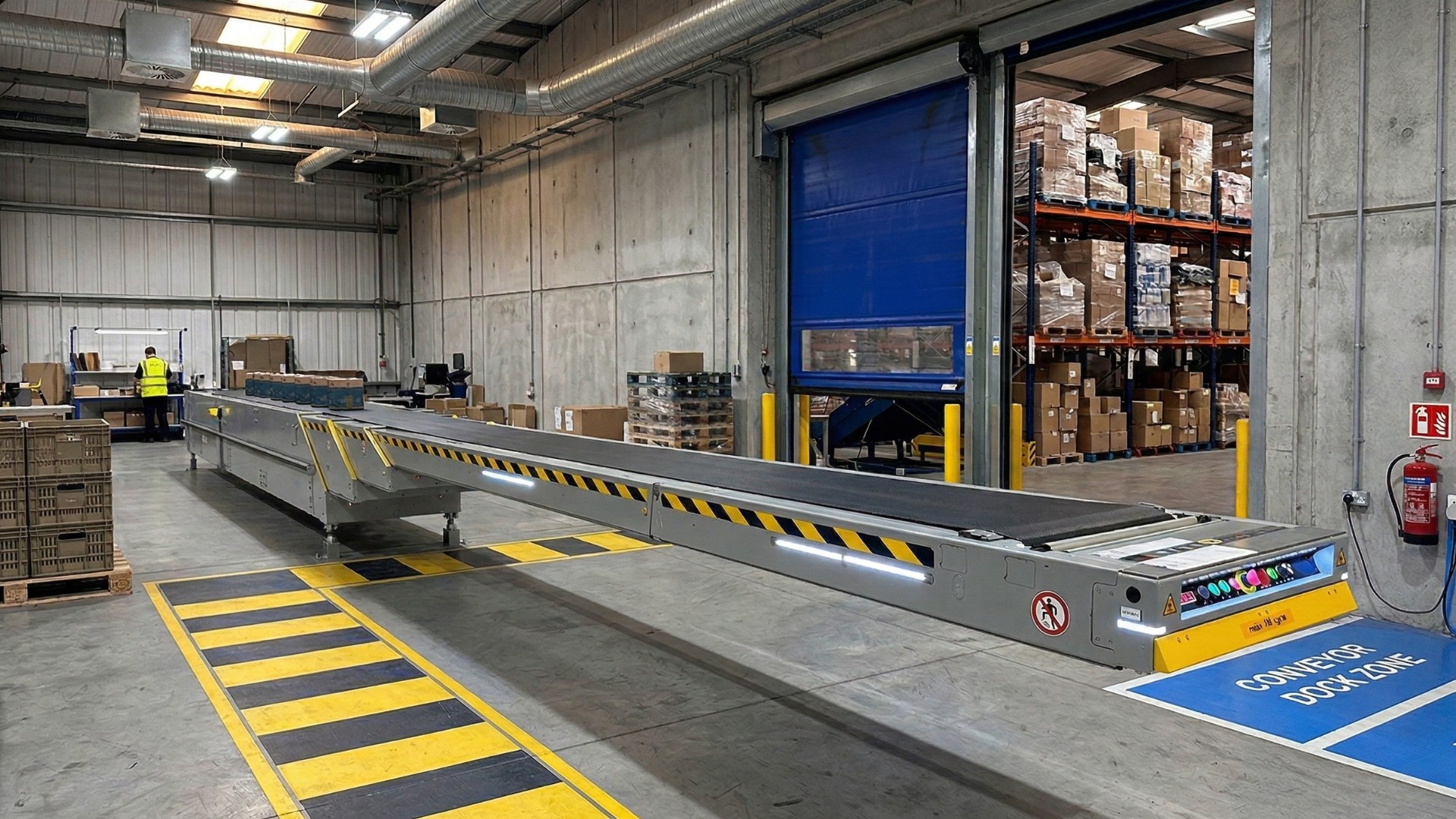
They integrated a series of telescopic conveyors into their inbound flow. These units were chosen because they are built properly, solid enough to handle constant use but nimble enough to be repositioned by a single operator.
During the first six months, including the Christmas peak, the units maintained a zero-fault record. The loaders actually used them because the interface was intuitive, and they didn’t have to fight the machine to get it to the container face. The carrier has since scaled the installation to nearly a dozen units. It turns out that portable machinery can actually outperform fixed installations when the engineering is right.
The Specification Shift
For those of us designing these systems, specifying fixed infrastructure is becoming harder to justify to a Customer. A modular approach is simply more sensible.
- Installation: You avoid the disruption of floor bolting. It is largely a plug-and-play exercise.
- Maintenance: If a unit needs a service, you wheel it out and wheel a spare in. The bay stays open.
- Scalability: You buy what you need for today’s volume. If the work grows, you add another unit. You don’t have to over-engineer for a “future peak” that might never arrive.
Building for Reality
Rigid equipment is a strategic risk in an unpredictable economy. By adopting flexible, telescopic solutions, UK hubs are doing more than just shaving seconds off an unload time. They are building operations that can actually survive a change in circumstances.
We aren’t just trying to manage today’s throughput; we are making sure the infrastructure isn’t the thing that holds the business back tomorrow.
When you look at your current loading bay setup, how much of that steel is actually working for you, and how much of it is just in the way?