How Parcel Hubs Can Improve Safety Without Slowing Down Throughput
Across parcel networks there is a constant tension between safety and productivity. Depot managers want faster turnaround times, planners want predictable departure waves and operators want an environment that supports their wellbeing. In reality these goals are heavily linked. When safety practices are weak, the physical strain on operators increases, inconsistency rises and throughput suffers. When safety improves, performance becomes more stable and sustainable.
A common belief in the industry is that improving safety slows down the operation. Yet the evidence across high volume hubs shows the opposite. Safer processes often enable faster, more consistent loading because they remove awkward movements, reduce fatigue and minimise the variations that create bottlenecks at the dock.
This article explores how parcel hubs can strengthen safety without sacrificing throughput and why safety and productivity should be seen as complementary rather than competing priorities.
Why Safety and Throughput Are More Connected Than Most People Think
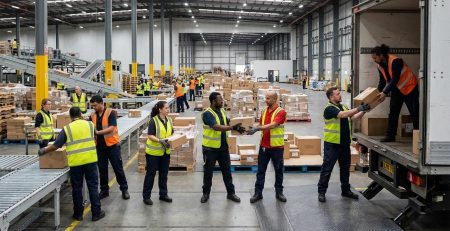
Many depot challenges stem from physical strain at the loading bay. Operators working on repetitive tasks become fatigued, and fatigue directly reduces speed and accuracy. Meanwhile, awkward postures inside vans and trailers create unpredictable handling patterns, making throughput harder to control. Safety and productivity issues share the same root causes.
Three links are especially important.
1. Physical strain reduces pace across the shift
The more a process depends on bending, climbing, twisting or stretching, the quicker operators slow down. A small reduction in pace early in the shift becomes a significant delay later on.
2. Unsafe workarounds create avoidable disruption
Inadequate reach, mismatched vehicle heights or congested dock fronts push teams into improvisation. Improvised actions undermine control and add unnecessary time to each load.
3. Inconsistent handling reduces predictability
Unsafe workflows are rarely consistent workflows. Variation in speed, posture and lifting patterns leads to unpredictable dwell times that make planning difficult. When depots address safety hazards, they often remove the very obstacles that limit consistent throughput.
The Most Common Safety Hazards in Parcel Loading
Parcel hubs share a common set of physical risks, many of which drive both injuries and performance issues.
Frequent climbing in and out of vehicles: Each climb adds strain on knees, hips and lower backs. It also adds walking time and disrupts the pace of loading.
Bending to floor level inside vans: Low vehicles force operators into awkward positions that slow handling and increase muscle fatigue.
Excessive reaching deep into trailers: Long reaches raise shoulder strain and slow movement, especially toward the end of shifts.
Poor visibility inside vehicles: Dark or inconsistently lit trailers lead to slower handling, misplacement of parcels and higher risk of slips or stumbles.
Congested dock fronts: Cluttered staging areas increase the risk of trips and force operators to walk further, adding time to every load.
Unstandardised task sequences: Without clear patterns, operators adapt movements on the fly, creating variation and a higher chance of mistakes.
These hazards are so common that many depots treat them as normal, but they have measurable impact on both safety and efficiency.
How Improving Safety Strengthens Throughput
Addressing key risk areas almost always increases pace for one simple reason: safer workflows are smoother workflows.
1. Reduced strain sustains pace for longer
Operators working with ergonomic movements maintain a more stable rhythm across the shift. Even a small improvement in posture can prevent the slowdown that typically occurs after the first two hours.
2. Consistency boosts predictability
When loading motions become standardised and safe, dwell times become more predictable. This unlocks better scheduling, smoother yard flow and more stable departure windows.
3. Safer bays reduce delays caused by incidents
Minor strains, missteps or near misses still disrupt loading even when no injury occurs. Fewer incidents mean fewer unplanned interruptions.
4. Improved working conditions support retention
Experienced operators work faster and make fewer errors. When safety reduces physical burden, turnover falls and teams retain more trained staff. Safety and performance strengthen each other. The best hubs pursue both together.
Practical Improvements That Boost Safety and Throughput at the Same Time
These actions require little or no capital investment and provide immediate benefits.
Improve lighting inside trailers and at the dock: Better visibility reduces hesitation and enables safer, smoother flow.
Reorganise staging areas to minimise walking distance: Shorter walking routes cut time and reduce fatigue.
Introduce standard loading patterns for vans and trailers: Clear, repeatable workflows remove unnecessary movements and support faster cycle times.
Rotate operators between heavy and light tasks: This helps maintain stamina and reduces physical overload on any one team.
Address posture pitfalls: Small aids such as anti slip mats or mid height platforms can ease strain and keep handling smooth.
Audit loading movements for hidden inefficiencies: Simple time and motion observations often reveal preventable strain that is slowing down the process.
These improvements help operators work more confidently and consistently, reducing both risk and dwell time.
Why Leading Parcel Hubs Put Safety at the Heart of Performance Management
High performing depots in Europe and the UK increasingly treat safety improvements as part of their efficiency agenda. Instead of separating safety from productivity, they view them as two sides of the same operational challenge.
This approach leads to:
- More stable throughput
- Fewer delays caused by fatigue
- Improved morale
- Smoother peak season performance
- More predictable departure waves
- Lower training costs due to improved retention
When safety is strengthened, reliability improves, and reliability is the foundation of every successful parcel operation.
Why Stable Working Conditions Lead to Superior Scheduling
Parcel hubs do not have to choose between safety and speed. In fact, improving safety is often the fastest route to improving throughput because it stabilises the physical conditions that drive performance. When operators can work comfortably and consistently, depots see measurable gains in dwell time, accuracy and schedule reliability.